History of the LEGO Brick: From 1932 to Today


From Wood to Plastic: The History of the LEGO Brick
When was the LEGO brick invented? Dive into its history, innovation, and why LEGO bricks still connect across generations.
The History of the LEGO Brick: How a Simple Block Became a Global Phenomenon

From humble beginnings in a Danish woodworking shop to becoming one of the world’s most beloved toys, the story of the LEGO brick is a tale of innovation, creativity, and enduring ingenuity. Today’s LEGO bricks connect millions of builders around the world, but their journey began with a simple idea and decades of engineering evolution.
Origins: From Wooden Toys to Plastic Innovation

The roots of LEGO stretch back to 1932, when carpenter Ole Kirk Christiansen founded a small toy company in Billund, Denmark. Initially, Christiansen produced wooden toys and household items during the hardships of the Great Depression. A few years later, in 1934, he named his company “LEGO,” derived from the Danish phrase “leg godt,” meaning “play well.”
After World War II, LEGO began experimenting with plastic, a cutting-edge material for toys at the time. In 1947, the company invested in Denmark’s first plastic injection-molding machine, a pivotal moment that would steer LEGO’s future. Two years later, in 1949, LEGO introduced its first plastic building elements called Automatic Binding Bricks—precursors to the modern LEGO brick.

Controversy and Inspiration: The Kiddicraft Connection

One of the most debated chapters in the history of the LEGO brick involves its resemblance to an earlier toy design created by British inventor Hilary “Harry” Fisher Page, founder of Kiddicraft.
In the late 1940s, Kiddicraft produced plastic interlocking building bricks known as “Self-Locking Building Bricks.” These bricks featured studs on top and were designed to connect together—an idea that closely resembles early LEGO bricks. Around the same time, LEGO founder Ole Kirk Christiansen began experimenting with plastic toys after acquiring an injection-molding machine, eventually introducing LEGO’s first plastic bricks in 1949.
The similarities between the two designs have led to long-standing discussion about whether LEGO directly copied Kiddicraft’s concept. Historical records indicate that LEGO did purchase sample Kiddicraft bricks, and early LEGO bricks shared several design elements with Page’s original invention. However, LEGO’s early versions lacked the internal tube structure that would later define the modern LEGO brick.
What ultimately set LEGO apart was innovation rather than imitation. In 1958, LEGO patented the now-famous stud-and-tube coupling system, dramatically improving clutch power and stability. This breakthrough transformed the brick from a simple stacking toy into a sophisticated construction system—one that Kiddicraft never fully evolved or protected through international patents.
After Fisher Page’s death in 1957, LEGO later reached an agreement with Kiddicraft’s successors to acquire rights to the original designs, effectively closing the chapter on the dispute. Today, LEGO openly acknowledges Kiddicraft’s influence, framing it as part of the broader evolution of interlocking building toys rather than an act of outright copying.
This episode highlights an important truth about LEGO’s success: while the idea of interlocking bricks was not entirely original, LEGO’s commitment to refinement, precision manufacturing, and long-term system-based play is what turned the LEGO brick into a global icon.
The Breakthrough: Stud-and-Tube Coupling System (1958)
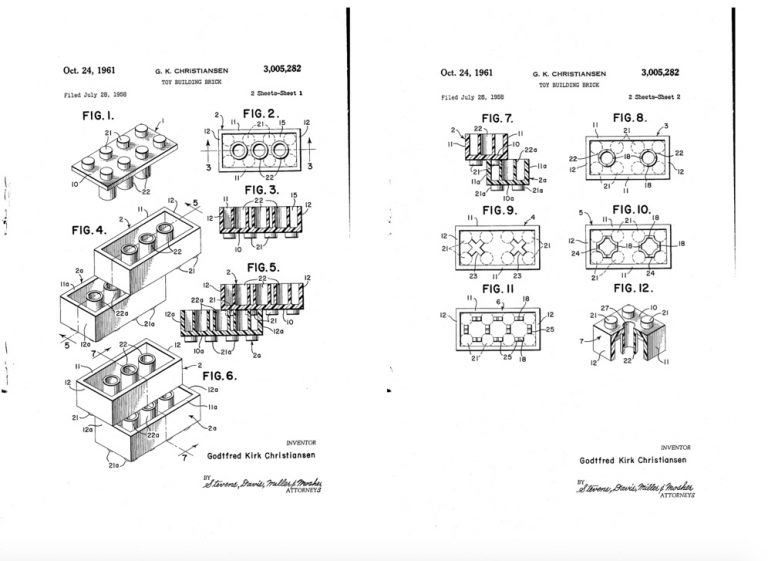
The defining moment in LEGO’s history came in 1958, when Ole’s son, Godtfred Kirk Christiansen, developed and patented the stud-and-tube coupling system that defines today’s LEGO brick. This innovative design featured hollow tubes under the top studs, dramatically improving the bricks’ ability to interlock firmly while still being easy to separate.
This coupling system transformed LEGO from a simple plastic toy into a versatile building system capable of endless creative possibilities. The compatibility of bricks across sets and generations became a hallmark of the LEGO brand—bricks produced in 1958 still connect perfectly with those made today.
Early Expansion & the LEGO System of Play
Once the modern brick was established, LEGO expanded rapidly. In the 1950s and 1960s, new elements like windows, doors, and wheels broadened what builders could create. LEGO also began marketing its toys as a System of Play, emphasizing how parts worked together rather than as standalone pieces.
The company introduced specialized products like DUPLO in 1969 for younger builders and LEGO trains in the mid-1960s. The first LEGOLAND park opened in Billund in 1968, further cementing the brand’s cultural impact.
Growth Into a Global Brand

By the 1970s, LEGO had spread far beyond Denmark, entering international markets and building a global fan base. In 1978, the iconic minifigure was introduced—an element so influential that it became synonymous with the LEGO experience.
Over the following decades, LEGO continued to innovate with new themes, licensed partnerships, and advanced sets that appealed to both children and adult builders. LEGO products expanded into video games, movies, and even architectural models, demonstrating the brand’s versatility and broad cultural appeal.
Why the LEGO Brick Endures
What makes the LEGO brick remarkable isn’t just its physical design — it’s the way that simple elements can be combined to create nearly anything. The stud-and-tube system allows a degree of creativity and flexibility found in few other toys. This design philosophy has helped LEGO remain relevant for nearly a century.
Today, LEGO continues to evolve. Recent innovations like the Smart Brick, a next-generation interactive element unveiled in 2026, aim to blend physical play with digital interactivity, proving that the LEGO system continues to adapt and inspire.
The LEGO Brick: Cultural Impact and Legacy
From home playrooms to world-record builds, the LEGO brick has become a cultural icon. Museums, exhibitions, and theme parks celebrate its history, and builders across generations use LEGO elements to tell stories, learn through play, and express artistic creativity.
LEGO’s enduring popularity stems from its core promise: the freedom to build, remake, and imagine without limits—an idea that began with a Danish carpenter’s workshop in 1932 and has grown into a global creative phenomenon.